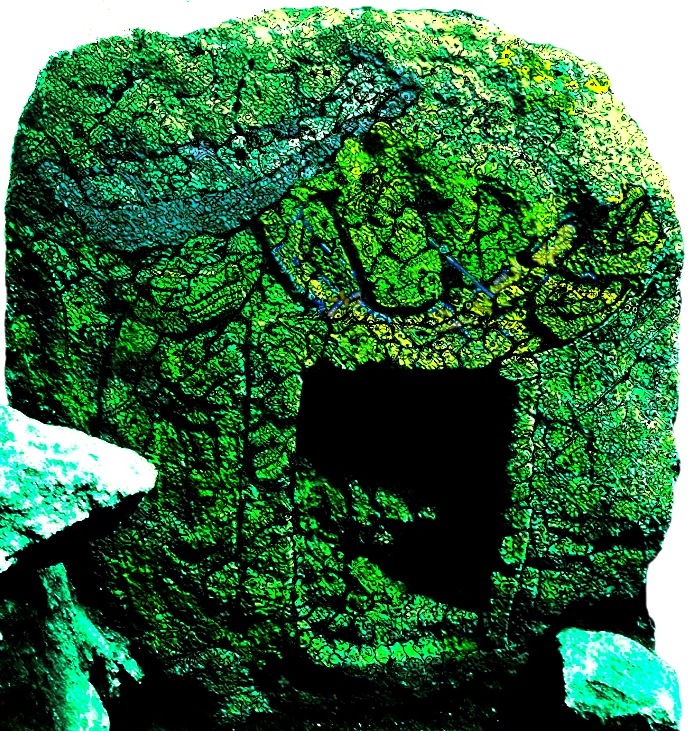
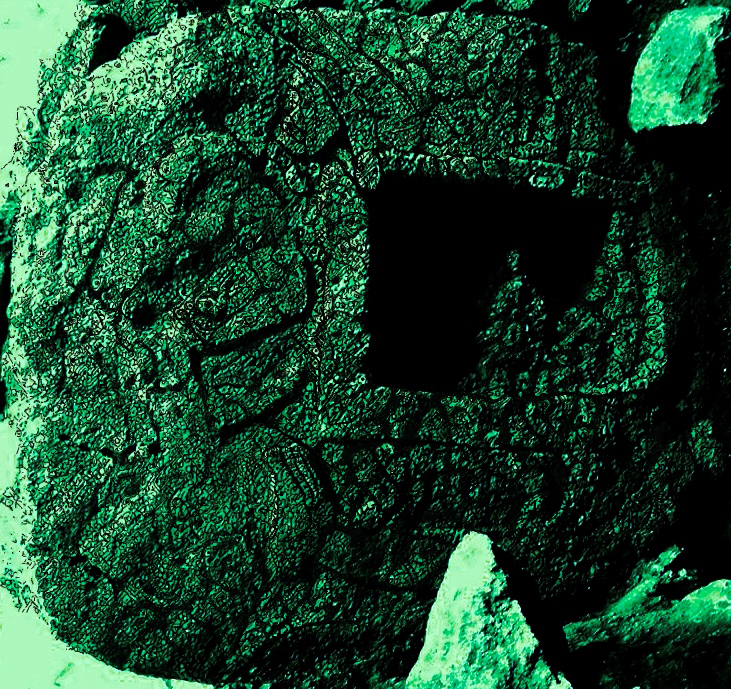
It seems as if half the experts in the world have visited this wondrous ancient site in Turkey. It is said to date back to the 10th/8th millennium BCE and remains a great mystery. Why was such a vast structure buried and preserved in situ? What was its purpose? Who were the builders? A google search on the name will reveal how many notable answers have been offered up so far. I follow new discussion on an excellent FB page ::: https://www.facebook.com/groups/692082857480641/?multi_permalinks=1435929836429269¬if_t=group_activity¬if_id=1491710577152364 ::: One recent post caught my eye because it featured a recently discovered (portal) stone. The picture was of decent quality so I figured to save/crop and analyse it for imagery. The results are below… showing the original with grateful thanks to the authors here :::: https://tepetelegrams.wordpress.com/2017/04/03/two-foxes-and-a-bucranium-the-first-in-situ-porthole-stone-from-gobekli-tepe/ :::: I spend so many hours on this to get the best basic settings, and then using Elements9 to carry out delineations at 1 pixel point line size – before final emphasis shading. I found also as per other world sites where this ancient language of illustration survives that the seeming impossible was achieved. In this case, when the picture/stone was rotated anti-clockwise through 90 degrees, it showed a completely different picture landscape. I will leave it the viewer to make of it what they will, but I urge anyone interested to view these pics greatly enlarged on your own screen. It is only in this way that the incredible micro (fractal) images and scenes can be viewed.

- Comment
- Reblog
-
Subscribe
Subscribed
Already have a WordPress.com account? Log in now.
 The walls of ancient record